Flag of Antigua and Barbuda Caribbean citizenship

Information current as of July 2026

Antigua and Barbuda citizenship by investment

Running since 2013 under the Citizenship by Investment Act, the programme covers a family of up to four on a single application for a contribution of $230,000 to the National Development Fund.
The process is handled remotely, with just five days in the country required during your first five years as a citizen.

Visa-free travel to over 150 destinations

Schengen Area United Kingdom Singapore China
Minimum investment
$230,000
Processing time
3-6 months
Application process
fully remote
Family application
up to 4 people
Residency requirement
5 days in 5 years
About the programme

What Antigua and Barbuda citizenship gives you

An Antigua and Barbuda passport opens up visa-free access to the UK and the Schengen Area, a zero-tax regime on worldwide income and capital, and the broadest family eligibility rules in the Caribbean.

How the programme works

Legal basis, governing authority and how to apply

LAUNCHED
2013
GOVERNING AUTHORITY
Citizenship by Investment Unit
HOW TO APPLY
Through a licensed agent only
STATUS
Open and running since 2013

What the passport gives you

The practical benefits for you and your family

01
150+
visa-free destinations
Stays of up to 90 days within any 180-day period across the Schengen Area. The UK allows visits of up to 180 days with an electronic travel authorisation. Visa-free entry does not carry the right to work or settle.
Schengen AreaUnited KingdomSingaporeChinaCARICOM
02
0%
income, capital gains and inheritance tax
Personal income tax was abolished in 2016. There is no capital gains, inheritance or wealth tax. Citizenship alone does not change your tax residency, which is established separately.
03
Passport valid for 5 years
The passport is issued for five years. Renewal is granted provided the holder has spent at least five days in the country during that period.
04
One application, whole family
A spouse and children up to the age of 30 are included in a single application. Parents and grandparents aged 55 and over, along with unmarried siblings, can be added where financial dependency is evidenced.
05
Dual citizenship permitted
Antigua and Barbuda recognises dual citizenship. You keep your existing passport, and there is no language test.
06
Passed on to future generations
Citizenship is granted for life and passes to children and grandchildren by descent. Children born after the grant acquire citizenship at birth.
07
Five days in five years
The only residency obligation is to spend at least five days in the country during your first five years as a citizen, which a single trip covers. The application itself is handled remotely, and interviews for applicants aged 16 and over are normally held by video call.
The number of visa-free destinations varies between passport indices and changes as visa agreements are revised. Antigua and Barbuda nationals require a visa to enter the United States, and the conditions for obtaining one changed in 2026. The limitations of the status are set out in full in the risks section below.
Costs

Antigua and Barbuda citizenship costs

The programme offers four investment routes. Below we set out the two most widely used, list every government fee that applies and give a full costing for a family of four, with nothing left off the bill.

Investment options

The main routes approved by the Citizenship by Investment Unit

Most popular route
Contribution to the national development fund
National Development Fund
US$ 230,000
A non-refundable contribution to a government fund that supports national priorities such as infrastructure, healthcare and education. This is the quickest and most predictable route available.
$230,000 covers a family of up to four, with no increase
Government fee: $10,000 for a single applicant, $20,000 for a family of up to four
From the fifth dependant onwards, the government fee rises by $10,000 per person
Non-refundable
Property purchase
Real Estate Investment
US$ 300,000
The purchase of a unit in a government-approved development, typically a resort residence or apartment. This is the only route where the capital can be recovered.
The property cannot be resold for five years from the date of purchase
Two applicants may invest jointly, provided each contributes at least $300,000
The government fee matches the fund route, from $10,000
Capital recoverable after 5 years

Additional fees

Payable separately from the investment. Due diligence fees are not refunded if an application is refused

Due diligence
Charged for the main applicant and every dependant over the age of 11. Children under 12 are exempt. Payable in full on submission and non-refundable.
$8,500
main applicant, spouse $5,000
Government fee
Applies to every route. 10% is payable on submission, with the balance due once the approval letter is issued.
$20,000
family of up to four, single applicant $10,000
Due diligence for children and older relatives
Children aged 12-17 are charged $2,000. Dependants aged 18-30 and parents aged 55 and over are charged $4,000 each.
$2,000
children aged 12-17
Passport fee
Charged for the issue of a passport to every person named on the application, children included.
$300
per person
Mandatory interview
Required of the main applicant and every dependant aged 16 and over, normally held by video call. The Unit does not publish a separate fee for this.
Required
since November 2023
Two further routes are available alongside the two above. The University of the West Indies Fund: $260,000 including processing fees, open only to families of six or more, with a one-year tuition scholarship for one family member. Business investment: from $1,500,000 as a sole investor, or from $5,000,000 jointly with each participant contributing at least $400,000. Applications are accepted only through a licensed agent, and the Unit does not deal with applicants directly. Agent fees, legal work on a property transaction, translation and legalisation of documents fall outside the schedule of government fees.

Total cost for a family of four

Costed for a couple with two children under 12. Government costs only, excluding agent fees. Children under 12 pay no due diligence fee.

National Development Fund contribution
$264,700
lowest total available
Investment $230,000
Due diligence $13,500
Government fee $20,000
Other fees $1,200
Property in an approved development
$334,700
capital recoverable after five years
Investment $300,000
Due diligence $13,500
Government fee $20,000
Other fees $1,200
Costed for a couple with two children under 12. The due diligence line covers $8,500 for the main applicant and $5,000 for the spouse; children under 12 are exempt. Other fees cover four passport fees at $300 each. Your total will depend on who is included and which route you take: children aged 12-17 add $2,000 each, and dependants aged 18 and over and parents aged 55 and over add $4,000 each. Agent fees, legal work on a property transaction, translation and legalisation of documents are not included. We will prepare an exact costing for your circumstances during a consultation.
Eligibility

Who can apply

The programme sets conditions on age, reputation and the source of your capital. Separate restrictions apply on the basis of nationality.

Restricted nationalities

Most nationalities on the list can still be considered on a case-by-case basis

Six restricted countries and two suspensions
Applications from nationals of six countries are considered individually, subject to strict conditions. Processing of Russian and Belarusian applications has been suspended under a separate decision.
Afghanistan
Iran
North Korea
Somalia
Legal basis: the Citizenship by Investment Act 2013 and the Regulations 2014, as amended in 2024. The list was approved by Cabinet decision of 26 February 2020 and covers six countries: Afghanistan, Iran, North Korea, Somalia, Sudan and Yemen. An application remains possible where the person left the country before reaching the age of majority, or has held permanent residence elsewhere for at least 10 years and retains no economic ties. Russian and Belarusian applications have been suspended since March 2023. A licensed agent will assess your position before anything is submitted.
Affected by these restrictions?
Some Caribbean and Pacific programmes apply less restrictive rules. We will find the route that fits your position.
Find my programme

Requirements for the main applicant

Verified for every person named on the application

Aged 18 and over
The main applicant must be an adult. A spouse, children up to 30, parents aged 55 and over and unmarried siblings are included under separate rules.
Clean criminal record
A police certificate is required from your country of nationality and from every country you have lived in for more than six months over the past decade. Refusals under other programmes must be disclosed.
Legitimate source of funds
The origin of the money must be documented across the full chain, covering both the source of funds and the source of wealth.
No sanctions
Screening against international sanctions lists, wanted-person databases and politically exposed person status.
Medical clearance
A medical report is required for the applicant and every dependant. An application is refused where a contagious or serious illness is identified.
A complete file
An incomplete file is the single biggest cause of delay. Applications go through a licensed agent only, and direct approaches are not accepted.
An interview has been mandatory since November 2023 for the main applicant and every dependant aged 16 and over. It is normally held by video call. The Unit does not publish a separate fee for it. Failing to attend, or answering unsatisfactorily, results in refusal.

Do you need to visit the country

The application is remote, but five days in the country over five years are compulsory

No relocation, but you will need to visit
Applying for and receiving the status is handled remotely through a licensed agent. During your first five years as a citizen, however, you must spend at least five days in the country. A single trip covers it.
What happens if you do not
The Unit may revoke citizenship where the requirement has not been met within five years, and the investment is not returned. Passport renewal is tied to the same five days.
The rules may tighten
Caribbean programme terms are subject to change by the government and are revised regularly. An increase to 30 days is under discussion under the regional agreement, though as of July 2026 the five-day rule still stands. We confirm the current position before any submission.
Family

Citizenship for the whole family

A contribution of $230,000 covers the main applicant and up to three dependants, with no increase in the sum. From the fifth person onwards, a government fee of $10,000 per head applies.

Spouse
No age limit
Included on equal terms with the main applicant. A marriage certificate and a full set of documents are required.
Added to investment within the $230,000
Due diligence $5,000
Children under 18
Aged 0 to 17
Included as financial dependants. Due diligence begins from the age of 12.
Added to investment within the $230,000
Due diligence 0-11: none, 12-17: $2,000
Children aged 18 to 30
Aged 18 to 30
Financial dependency on the main applicant is enough, with no need to evidence study. Children with a disability are included with no upper age limit.
Added to investment within the $230,000
Due diligence $4,000
Parents and grandparents
Aged 55 and over
Parents and grandparents of the main applicant or spouse, where financial dependency is evidenced. The age threshold is among the lowest in the Caribbean.
Added to investment within the $230,000
Due diligence $4,000
Who pays for due diligence
Main applicant $8,500, spouse $5,000, children aged 12-17 $2,000, dependants aged 18 and over and parents aged 55 and over $4,000. Children under 12 are exempt. Payable on submission and non-refundable.
Siblings can be included
Unmarried siblings of the main applicant or spouse can be named on the application. Few Caribbean programmes allow this.
Children born after citizenship is granted
A child can be added once the passport has been issued. The fee is $10,000 for a child under 5 and $25,000 for a child aged 6 to 17.
A passport fee of $300 is payable for each person named on the application. Caribbean programme terms are revised regularly, so we confirm who can be included before any submission.
Documents

Documents required for Antigua and Barbuda citizenship

A separate file is compiled for the main applicant and for each dependant. Below are the main categories of document and the rules on how each must be certified.

Personal documents
Passports and national identity documents for everyone named on the application
Birth, marriage and divorce certificates. The original birth certificate is required for the passport to be issued
Proof of address, such as a utility bill or a bank statement issued within 3 months
Photographs to the required specification and the official programme forms, completed through a licensed agent
Background and health
A police certificate for everyone aged 16 and over, from each country lived in for more than six months over the past decade issued within 3 months
A medical report including HIV test results for every applicant, children included issued within 3 months
A professional reference from a solicitor, accountant or notary issued within 6 months
Anyone who has lived in Canada needs an RCMP certificate; CPIC checks are not accepted
Funds and employment
A bank reference on headed paper, together with account statements issued within 3 months
Evidence of the source of funds and source of wealth across the full chain
An employer letter stating your position and income, or company documents if self-employed
Evidence of financial dependency for each dependant other than the spouse
How documents must be certified
Documents issued outside Antigua and Barbuda must carry an apostille and a notarised English translation. Where a police certificate cannot be obtained, a statutory declaration setting out the steps taken is submitted in its place.
A file for every applicant
Certificates and medical reports are prepared separately for each person. The property route adds a sale and purchase agreement together with proof of payment. Once citizenship is granted, the name on the passport cannot be changed.
The order you collect them in matters more than the list
In most countries a police certificate takes two to three months to obtain and remains valid for only three. The same three-month window applies to the medical report, the bank reference and proof of address. That leaves very little room for error, which is why sequencing matters. We will draw up a schedule for your circumstances during a consultation.
The application process

Stages and timelines to passport

Seven stages from the first consultation to the passport in hand. Applying and receiving the status are both handled remotely.

End-to-end timeline
from 4 months
The Unit works to a target of 3-6 months from the date a complete file is lodged. In practice, complex cases can run to eight months. The figure above includes preparing documents before submission.
Agent submission only
The Unit does not accept applications directly from investors. There is no fast-track route available for an additional fee.
1
Assessment and choice of agent
A licensed agent runs preliminary checks and helps you settle on one of the four investment routes.
1-2 weeks
2
Collecting and legalising documents
The longest preparatory stage. A police certificate takes two to three months to obtain and is valid for only three, so it is the first thing to request.
4-8 weeks
3
Submission through the agent
Due diligence fees are paid in full on submission, along with 10% of the government fee. The official timeline runs from this date.
1 week
4
Due diligence and interview
Checks are carried out by independent international firms. An interview is mandatory for the main applicant and every dependant aged 16 and over, held by video call.
up to 12 weeks
5
Approval in principle
The Unit issues an approval letter. This is a decision on the applicant, not a grant of citizenship.
1-2 weeks
6
Making the investment
The contribution is made only after approval and strictly within 30 days. The balance of the government fee and the passport fees fall due at the same point.
30 days
7
Certificate, passport and oath of allegiance
A certificate of registration is issued, followed by the passport. The oath of allegiance is taken on your first visit to the country or at a consulate abroad.
6-8 weeks
Timelines reflect official programme data and agent practice. A single regional regulator, ECCIRA, has been in place since 2026, and biometric capture along with an increase in the residency requirement to 30 days are both under discussion. As of July 2026 the rule remains five days in five years. We confirm the current position before any submission.

Let us calculate the cost for your family

The final amount depends on your family composition, the ages of your children and the investment option you choose. We will prepare a full estimate covering every fee and check whether the programme suits your situation.

No-obligation estimate
Reply within one working day
Eligibility assessed before filing
Get an estimate
The consultation is free

Tax, residency and ongoing obligations

Antigua and Barbuda citizenship alone does not change your tax residency, though it does carry a minimum presence requirement. Below is what the passport gives you and what you remain accountable for.

When tax residency applies

183 days
a year in Antigua and Barbuda
Citizenship alone does not establish tax residency. The alternative is the permanent residency programme, with a flat annual tax of $20,000 and a minimum of 30 days in the country.

Tax in Antigua and Barbuda

0%
income tax for all residents
Personal income tax was abolished in 2016 and applies to neither local nor foreign income. There is no capital gains, inheritance or wealth tax.
Sales tax (ABST) is charged at 15%, corporation tax at 25%, and property tax at 0.1-0.5% of assessed value.

Presence requirement

5 days
within your first 5 years as a citizen
There is no need to relocate and the application is handled remotely. The five-day requirement is binding, but a single trip covers it.
An increase to 30 days is under discussion through the ECCIRA regulator. As of July 2026 the five-day rule stands.

Passport renewal

5 years
passport validity; citizenship is for life
Citizenship is granted for life and only the document itself is renewed. Renewal is granted where the five-day presence requirement has been met.
Where it has not been met, the Unit may refuse renewal and revoke the status. The investment is not returned.
Obligations elsewhere still apply
A second citizenship does not remove reporting duties or tax liability wherever you remain tax resident. Antigua and Barbuda participates in the automatic exchange of financial information. Tax consequences depend on your own circumstances, and we do not provide tax advice.

Risks and limitations

The programme is not right for everyone, and a refusal costs more than the fees already spent.
Below is what leads to refusal and what the passport does not give you.

Grounds for refusal

The most common reasons an application is turned down

Unclear source
of funds
Gaps in the chain of origin, or funds that cannot be evidenced with documents.
Adverse
background
A conviction carrying over six months custody, a visa refusal by a visa-free country, or a sanctions listing.
Incomplete or
inconsistent file
Discrepancies in dates, addresses and figures across documents from different years and countries.
An undisclosed
previous refusal
Refusals under other programmes must be disclosed. Concealment comes to light during due diligence.
Interview and
health
An interview is mandatory for everyone aged 16 and over. A serious or contagious illness is also grounds for refusal.
A refusal can close the door on other programmes too
The five Caribbean programmes share applicant data through ECCIRA, their single regulator.
A refusal in one country is recorded and taken into account by its neighbours. Getting the assessment right before submission matters far more than moving fast.

What the passport does not give you

Expectations the programme does not meet

The right to live and work in the EU
The Schengen Area allows stays of up to 90 days within any 180-day period, and the UK up to 180 days with an electronic travel authorisation. Neither carries the right to work or settle.
Automatic tax residency
Tax status follows where you actually live, not which passport you hold. Your obligations in your country of residence remain.
Unrestricted entry to the United States
Since 1 January 2026 the United States has restricted the issue of visitor, student and immigrant visas. Visas issued before 31 December 2025 remain valid.
Release from financial reporting
Accounts stay within the automatic exchange of information. A second citizenship does not move assets beyond the reach of your country of residence.

Who the programme is not for

Situations where another route makes more sense

Restricted nationalities
Six countries are restricted, with processing suspended for Russia and Belarus. Set out in the eligibility section.
Regular travel to the US
Since 2026 an Antigua passport no longer serves this purpose. Consider St Kitts and Nevis, Grenada or Saint Lucia, none of which were affected.
Budget stretched to the headline price
A family of four faces a total from $264,700 on the cheapest route. Applying without headroom for fees is a risk.
Funds hard to evidence
Where the source of funds cannot be reconstructed on paper, refusal is likely and the fees are not returned.

What has changed and what may change next

Programme terms are revised regularly, so plan with room to spare

In progress
An increase in the presence requirement from 5 to 30 days is under discussion through the ECCIRA regulator. No implementation date has been announced.
February 2026
The United States cut B-1 and B-2 visitor visas for Antiguan nationals from 10 years to a single entry valid for three months.
January 2026
Partial US visa restrictions took effect. The government disputes the basis of the proclamation and is negotiating for it to be lifted.
August 2024
The fund contribution threshold rose to $230,000 and property to $300,000. A mandatory interview has applied since November 2023.
Our service

What our service covers

We run the process from the first assessment through to the passport, and stay on afterwards for company and banking work.

Assessment before you commit
We review who is applying, where the money comes from and your background before any work starts. If the risk of refusal is high, we say so at once.
Preparing and legalising documents
A police certificate is valid for only three months. We build the collection schedule around that window and arrange apostilles and translation.
A full costing
We calculate the total for your family and chosen route: contribution, government fee, due diligence and passports. No surprises along the way.
Submission through a licensed agent
Applying through an agent is a requirement of Antiguan law. We prepare the file and deal with the agent on your behalf.
Tracking at every stage
We follow the application as it moves, draft responses to queries from the Unit and prepare you for the video interview.
Support after citizenship is granted
We help plan the five days in the country, renew the passport and add new dependants later on.
The Unit cannot be approached directly, as the law allows submission only through a licensed agent. Our role is preparing the file, checking it and running the process, then handling corporate and banking work once citizenship is granted.

What Caribbean providers do not offer

A passport is rarely the end in itself. Behind it sit commercial questions: where to hold the company, where to open an account, how to structure it all. We handle those with the same team that ran your application.

Company formation
Over 30 jurisdictions, including Hong Kong, Singapore, the UAE and across Europe. We build the structure around the task rather than a template.
Corporate and personal accounts
We work with banks and payment institutions across several regions. Account opening is subject to the bank's own approval.
Banking support
We prepare the pack to meet compliance requirements, see it through review and assist with bank queries once the account is live.
Programme comparison

Alternative citizenship programmes

5 programmes

Antigua and Barbuda is not the only option, and not always the best one. Below is a comparison against four comparable Caribbean programmes, including the points where Antigua comes off worse.

Criterion
Antigua and Barbuda
St Kitts and Nevis
Grenada
Dominica
Saint Lucia
Investment from
$230,000
$250,000
$235,000
$200,000
$240,000
Processing time
3-6 months
6-9 months
4-6 months
4-5 months
3-4 months
Presence required
5 days in 5 years
None
None
None
10 days in 5 years
Capital recoverable
After 5 years
on the property route
After 7 years
After 5 years
After 3-5 years
After 5 years
Who can be
included
Up to 4 people,
siblings included
parents from 55
Up to 4 people
Up to 4 people
Up to 4 people
Up to 4 people
Standout feature
Broadest family
eligibility
Oldest programme,
running since 1984
Access to the
US E-2 visa
Lowest entry
threshold
Fastest
processing
Figures are for a single main applicant on each programme's cheapest route, before fees. Programme terms are subject to change by the government, so we confirm the current position before any submission. Highlighted in green are the points where other programmes beat Antigua.

Other Caribbean programmes

We will match a programme to your circumstances, your family and your budget
Results

Cases from our practice

Three situations with different budgets, family structures and objectives. We show not just the outcome but what was discussed at the outset.

Real cases from our practice. Client names and outcomes are published with their consent.

Citizenship
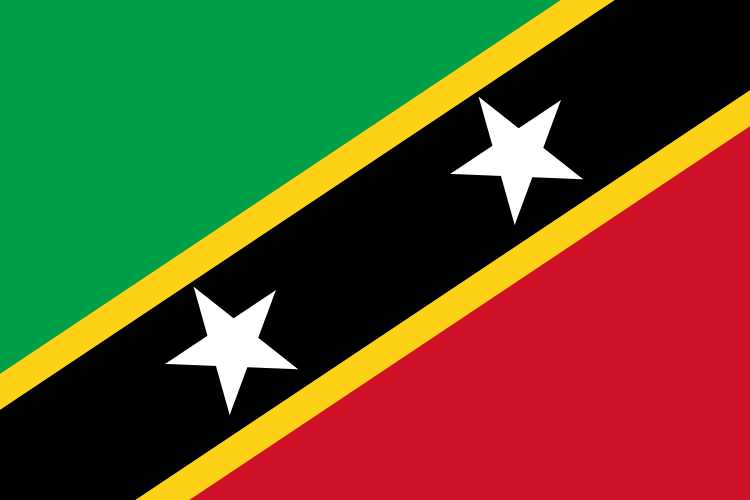
Flag of St Kitts and Nevis St Kitts and Nevis

A family of four, a plan B without relocating

The owner of a logistics company in Turkey, an Iranian national. Two children, aged 16 and 11. Relocation was never the point: the business stays where it is, and he wanted a second passport so as not to depend on a single visa basket and to travel freely to Europe and Asia. He was weighing St Kitts against Grenada and leaning towards Grenada on price.

Solution: We costed the full budget for four under both programmes. The gap was narrower than expected, while St Kitts won on passport strength and on how quickly banks recognise it. We went with the fund contribution. Two points were flagged separately: police clearance certificates from Iran and Turkey had to be started first, and the elder son would age out within eighteen months, so there was no room to delay. Biometrics were combined with a business trip to Dubai.


9 months from first meeting to passports
4 passports under one application

I was convinced Grenada would come out noticeably cheaper and had almost decided. Once both estimates were laid out with every fee, the difference was not enough to justify losing passport quality. My son turning sixteen had not crossed my mind at all, so thank you for saying it straight away rather than once we had already gathered half the paperwork.

KA
Kaveh A. Logistics, Turkey
Citizenship
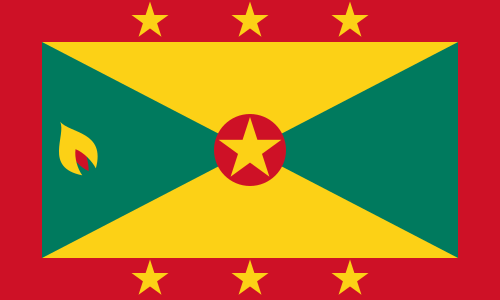
Flag of Grenada Grenada

A single applicant, the goal was business in the US

A developer from Serbia with his own fintech product, his main market being the US. He wanted to set up a company there and run it in person, but no work visa fitted his case on a Serbian passport. He came asking about St Kitts, simply because he had heard of it most.

Solution: St Kitts did not solve his problem. Grenada holds a treaty of commerce and navigation with the US, and that is what opens the door to an E-2 investor visa. We rebuilt the plan: Grenadian citizenship first, then a US company and the visa application. We were upfront that the passport does not grant the visa, that the consulate decides, and that the process would take several more months after citizenship. That was exactly what he had expected.


10 months to passport in hand
$235,000 fund contribution

I came for one thing and left with another, and it turned out to be right. They could have simply sold me what I asked for and I would never have realised I had bought the wrong thing. What I particularly valued was being told straight about the visa: no guarantees, the consulate decides. After two consultations elsewhere where I was promised practically everything at once, that came as a surprise.
MJ
Milos J. Fintech, Serbia
Citizenship
Flag of Vanuatu Vanuatu

A married couple, budget and timing decided everything

A couple from Kazakhstan, both self-employed: he consults on industrial automation, she runs a small agency. They needed a second document for travel and for opening accounts, with no tie to any particular country. Caribbean programmes were outside their budget, and they did not want to wait six months: a trip was already booked for the autumn, and that was the whole reason behind it.

Solution: On those terms Vanuatu suited them better than anything else: markedly cheaper, with processing measured in weeks rather than months. We set out the limitations at once so there would be no disappointment: the passport is weaker than the Caribbean ones on visa-free access and will not get you into the Schengen area. For their purposes that was acceptable, but the decision was made with eyes open. Documents were gathered in three weeks and both passports arrived together.


7 weeks from filing to passports
2 passports husband and wife

We understood that for this money we would not get a passport on the level of St Kitts, and we did not need one. What mattered more was that nobody tried to sell us something pricier and we were told honestly where Vanuatu falls short. The Schengen point was explained upfront, before we had paid anything. My wife was anxious about the timing, but it came in even faster than promised.

AS
Artem S. Industrial automation, Kazakhstan
FAQ

Frequently asked questions

If your question is not answered here, send us an enquiry and we will look at your situation individually.

Book a consultation

No agent can guarantee that citizenship will be granted. The decision rests with the Citizenship by Investment Unit following due diligence, and no one can influence it. Any provider promising a guaranteed outcome should be treated with caution. What genuinely reduces the risk is an honest assessment of your case before submission and full disclosure of anything due diligence would uncover in any event.

Restrictions apply to nationals of six countries: Afghanistan, Iran, North Korea, Somalia, Sudan and Yemen. The list was approved by Cabinet decision of 26 February 2020. An application remains possible where the person left the country before reaching the age of majority, or has held permanent residence elsewhere for at least 10 years and retains no economic ties there. Russian and Belarusian applications have been suspended since March 2023. A licensed agent assesses each case before anything is submitted.

No. Antigua and Barbuda recognises dual citizenship, so you keep your existing passport. There is no language test and no test on the country itself. Do check whether your own country permits dual citizenship, as some require you to notify them of a second passport or restrict it altogether.

Not to apply or to receive the status: the whole process runs remotely through a licensed agent, with the interview held by video call. Once citizenship is granted, however, you must spend at least five days in the country during your first five years. A single trip covers it. Where the requirement is not met, the Unit may refuse to renew the passport and revoke the status, and the investment is not returned.

On the National Development Fund route, from $264,700 for a couple with two children under 12. That covers the $230,000 contribution, a $20,000 government fee, $13,500 in due diligence and four passport fees at $300 each. On the property route, from $334,700. Children aged 12-17 add $2,000 each, and dependants aged 18 and over and parents aged 55 and over add $4,000 each. Agent fees, translation and legalisation of documents are not included.

The main applicant and every dependant over the age of 11. The fees are $8,500 for the main applicant, $5,000 for a spouse, $2,000 for children aged 12-17, and $4,000 each for dependants aged 18 to 30 and parents aged 55 and over. Children under 12 are exempt. The full amount is paid on submission and is not returned if the application is refused. Checks are carried out by independent international firms.

The passport is issued for five years. Citizenship itself is granted for life and does not expire; only the document is renewed. Renewal is granted provided you have spent at least five days in the country during those five years. This sets Antigua apart from most Caribbean programmes, where renewal is a formality.

Citizenship passes to children and grandchildren by descent. A child born after the grant can be added to the main applicant's file: the fee is $10,000 for a child under 5 and $25,000 for a child aged 6 to 17. Due diligence at the applicable age rate and a $300 passport fee are payable on top.

The UK, yes, with an electronic travel authorisation for stays of up to 180 days. The United States, no. Partial visa restrictions have applied to Antiguan nationals since 1 January 2026, affecting new applications for visitor, business, student and immigrant visas. Visas issued before 31 December 2025 remain valid. If travel to the US matters to you, Grenada, St Kitts and Nevis or Saint Lucia are worth considering, as none of them were affected.

The National Development Fund takes a non-refundable $230,000 and is the quickest route. Property starts at $300,000 and can be resold after five years. The University of the West Indies Fund is $260,000 including fees, open only to families of six or more, with a one-year scholarship for one family member. Business investment starts at $1,500,000 as a sole investor, or $5,000,000 jointly with each participant putting in at least $400,000.

There is no fast-track route available for an additional fee. The only real way to shorten the timeline is the quality of preparation: a complete file with no inconsistencies clears due diligence faster. The Unit works to a target of 3-6 months, and complex cases can run to eight. The contribution is made after approval and strictly within 30 days.

We will calculate
the budget and assess
your eligibility
We will review your situation before filing: family composition, source of funds, the right option.
We will tell you straight if the programme is not right for you.

Get an estimate

We will reply within one working day and prepare an estimate for your family

By clicking "Send request", you agree to the processing of your personal data in accordance with the Privacy Policy.