 Most affordable
Data current as of July 2026
Sao Tome and Principe
citizenship by investment
The citizenship by investment programme has been running since August 2025 under Decree-Law 07/2025. The contribution starts at $90,000 for a single applicant and $95,000 for a family of up to four to the National Transformation Fund. Processing takes from 2 months, with no requirement to visit the country.
Visa-free access to 60+ countries and territories
What Sao Tome and Principe citizenship gives you
The passport is issued in as little as 2 months, gives visa-free access to more than 60 countries and territories and requires neither residence nor a visit to the country. The contribution goes to the National Transformation Fund, financing energy, infrastructure and social projects.
How the programme works
Legal basis, authority and how to apply
Benefits of the Sao Tome and Principe passport
What the investor and their family actually get
How much Sao Tome and Principe citizenship costs
The programme has a single investment option - a non-refundable contribution to the National Transformation Fund. Below are all government fees and a full cost breakdown for a family of four, priced as of July 2026.
Investment option
The only qualifying route, approved by the Citizenship by Investment Unit
Cost for a family of four
A couple and two children. Government costs, excluding agent fees.
Associated fees
Paid separately from the contribution. The application fee is due on submission and is not refunded if the application is declined
Eligibility criteria for Sao Tome and Principe citizenship
The programme sets requirements on age, reputation and source of funds. There are no requirements on assets, education or business experience. It is open to most nationalities, including those excluded from Caribbean programmes.
Who cannot apply
One nationality exclusion and a temporary limit for holders of three passports
Requirements for the main applicant
Verified for every adult included in the application
Do you need to visit Sao Tome and Principe
No personal presence is required at any stage
Sao Tome and Principe citizenship for the whole family
The contribution is a single amount for a family of up to four - $95,000, not a separate sum per person. One application can include a spouse, children under 30, and parents and grandparents aged 55 and over.
Documents for Sao Tome and Principe citizenship
A file is prepared for each applicant. Documents are submitted in English or Portuguese. Below are the main groups and formatting requirements.
How to get Sao Tome and Principe citizenship: steps and timelines
Six steps from the first consultation to the passport. Everything is done remotely, with no visit to the country.
Let us calculate the cost for your family
The final amount depends on your family composition, the ages of your children and the investment option you choose. We will prepare a full estimate covering every fee and check whether the programme suits your situation.
Sao Tome and Principe tax, residence and obligations
Citizenship alone does not change your tax status and requires no presence in the country. Until you become a resident, there are no tax obligations there. Below is what the passport gives you and what obligations remain.
When tax residency arises
Non-resident worldwide income
Presence requirements
Passport renewal
Risks and limitations of Sao Tome and Principe citizenship
The programme is in its first year, and it does not provide visa-free access to the Schengen Area, the UK or the US.
Below are the main reasons for refusal, what the programme does not cover and who it is not suitable for.
The main reasons for refusal
The final decision is made by the Council of Ministers. The main reasons for refusal
of capital
databases
contradictory file
nationalities
restrictions
The application fee and the agent's fee are non-refundable. A pre-submission assessment matters more than speed.
What the Sao Tome and Principe passport does not give
Expectations that the programme does not meet
Who the programme is not for
Situations where it makes sense to consider other options
What has already changed and what may change
Terms are revised regularly, so plan with a margin
What our Sao Tome and Principe citizenship service covers
We handle the process from the first assessment to the passport, and beyond, when company and banking needs arise.
What we do that migration providers don't
The passport is rarely an end in itself. Behind it lie business needs: where to register the company, where to open an account, how to structure assets. We address these with the same team that handled your application.
Sao Tome and Principe citizenship vs alternatives: programme comparison
Sao Tome and Principe is not the only option, nor always the best. Below is a comparison with four similar programmes, including the areas where it falls short.
application
parents 55+
parents 50+
eligibility
parents 55+
threshold worldwide
in the world
eligibility
US E-2 visa
after 3 years
Alternative citizenship programmes
Find the programme that fits your situation, family and budget
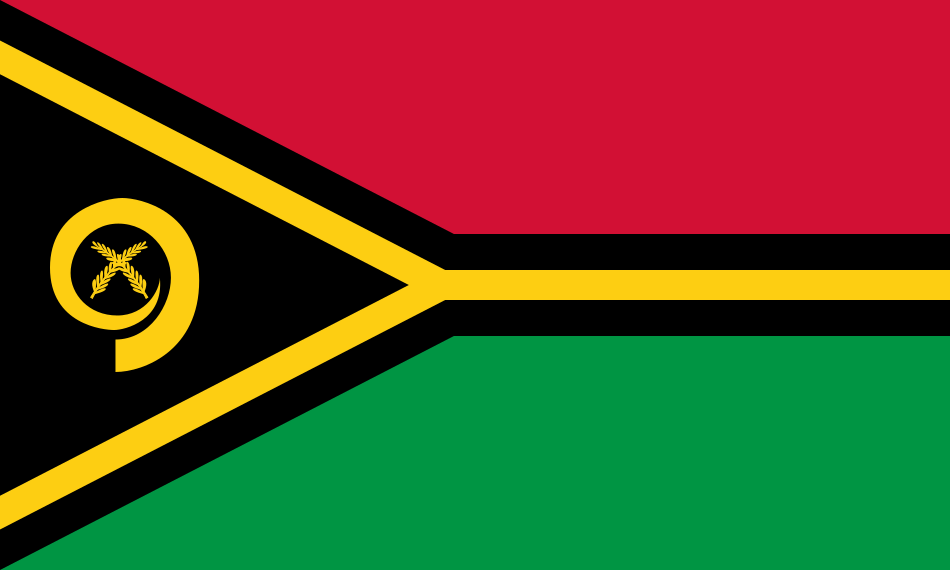
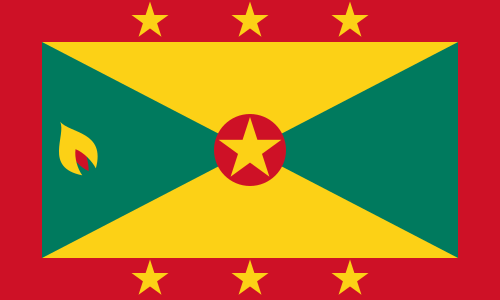
Cases from our practice
Three situations with different budgets, family structures, and goals. We show not just the outcome, but what was discussed at the start.
Real cases from our practice. Client names and results are published with their consent.
São Tomé and Príncipe A family on a tight budget, a passport as a fallback
An entrepreneur from Russia running a small online business. Wife and a seven-year-old son. They had no plans to relocate; he simply wanted a second document as a backup and the ability to open accounts without friction. The budget was tight: Caribbean programmes starting at $200,000 were off the table straight away. At first he was even looking at residency somewhere and had no idea citizenship at $90,000 existed.
Solution: We laid out the full cost for three: the $95,000 family contribution, the application fee, documents for each person. It came to around $105,000 before our fees. We were upfront about the downsides from the start: the passport is new, banks don't know it well yet, and it won't get you into the Schengen Area. For his goals none of that mattered. We also flagged that applications from people with three nationalities are currently on hold; he had two, so he was fine. He did his biometrics remotely from home, by video call with a notary.
Honestly, right up to the end I kept expecting some catch, some hidden fees to surface. There weren't any - the final figure matched the estimate almost to the penny. What I liked was that they didn't oversell the passport; they said plainly it's weak, it's new, it won't get you into Europe. I didn't need Europe. For that money I got exactly what I'd counted on, and no headaches.
Grenada Single applicant, goal is business in the US
A developer from Serbia with his own fintech product, main market in the US. He wanted to establish a company there and manage it in person, but a Serbian passport didn't fit any work visa category for his situation. He came in asking about St. Kitts, because that's what he'd heard about most.
Solution: St. Kitts wouldn't solve his problem. Grenada has a Treaty of Trade and Navigation with the US, and that's exactly what gives you the right to apply for an E-2 investor visa. We restructured the plan: first Grenada citizenship, then a US corporation, then visa application. We were honest upfront that a passport doesn't grant a visa - the consulate decides - and that the process would take several more months after he gets his citizenship. That's what he was counting on.
I came in for one thing and left with another, and it turned out to be the right call. They could have just sold me what I asked for, and I'd never have known the difference. What also stuck with me is how straight they were about the visa: no guarantees, the consulate decides. After two consultations elsewhere where I was promised the sun and the moon, that was unexpected.
Vanuatu A couple where budget and timeline determined everything
A pair from Kazakhstan, both self-employed: he consults on industrial automation, she runs a small agency. They needed a second document for travel and opening accounts, with no specific country requirement. Caribbean programmes were out of budget, and they didn't want to wait six months: they'd planned a trip for autumn, which is what prompted all this in the first place.
Solution: Vanuatu fit their brief better than anything else: significantly cheaper, and the process takes weeks, not months. We discussed the limitations upfront so there'd be no disappointment later: the passport is weaker than Caribbean ones on visa-free access, and you won't get into the Schengen Area. For their needs it was acceptable, but they made the decision with open eyes. We gathered documents in three weeks, and both passports arrived together.
We knew we weren't getting a St. Kitts-level passport for this price, and we didn't need one. What mattered was that they weren't trying to upsell us something more expensive; they were honest about where Vanuatu's limitations are. They explained the Schengen thing upfront, before we committed to anything. My wife was anxious about the timeline, but they even beat their own deadline.
Frequently asked questions
If your question is not answered here, get in touch and we will look at your situation directly.
Request a consultationNo agent can guarantee that citizenship will be granted, and no reputable provider claims otherwise. The application goes through due diligence at the Citizenship by Investment Unit, the file is then passed to the Council of Ministers, and the Council makes the final decision. No agent can influence it, so a promise of a guaranteed outcome is a reliable sign of a provider to be treated with caution. What genuinely lowers the risk of refusal is an honest assessment of your situation before submission, full disclosure of your source of funds and background, and a properly assembled file with no discrepancies between documents. It is at the pre-submission stage that the issues which would otherwise surface during the government due diligence - and cost you the fees - are caught.
This is actually one of the programme's strengths: the only citizenship exclusion is North Korean nationals. All other nationalities, including citizens of Russia, Iran, Afghanistan and Venezuela, apply on standard terms without additional conditions or higher fees. Stateless persons may also participate. There is a separate temporary restriction: from April 2026 onwards applications from individuals holding three or more foreign nationalities have been suspended pending an amendment to the Nationality Law 07/2022. Beyond nationality, refusal may result from an unclear source of funds, serious criminal conviction, Interpol red notice status, or matches on sanctions lists. We verify your eligibility status before submission.
No. Sao Tome and Principe allows dual and multiple citizenship, and there is no need to renounce your current passport. But there are two important points. First, check the laws of your own country - some states restrict a second citizenship or require you to notify the authorities, and that is their own rule, not a requirement of the programme. Second, specific to Sao Tome: if you already hold three or more foreign nationalities, applications in that category have been suspended since April 2026, pending an amendment to the law. With two nationalities or fewer, the limit does not affect you. You must declare all the passports you hold to the CIU - this is part of due diligence, and concealment is in itself grounds for refusal.
No, no visit to the country is required at any stage; the entire process is fully remote. Submission is through a licensed agent, and there is no interview in the programme at all - it does not exist as a stage. Biometrics are done remotely: since April 2026 this is a video call with a local notary, whereas before it required video identification through the registry office. The finished passport and documents are delivered by courier. There are no residence requirements before applying or after obtaining the passport - you are not obliged to live in the country or spend any number of days there to keep your citizenship.
Around $103,000 in government costs for a couple and two children. It breaks down as follows: the contribution to the National Transformation Fund for a family of up to four is a single amount, $95,000, not a separate sum per person. The application fee is $5,000 for the whole application, regardless of the number of people. The passport, national ID and Certificate of Registration are $750 each, so $3,000 for four. Document translation and notarisation are from $2,000. From the fifth applicant onwards, $5,000 is added to the contribution for each person. Agent fees are not part of the government costs and are discussed separately. We prepare a full breakdown for your family composition during the consultation.
The reason lies in the nationality law itself. Law 07/2022 contains a provision that does not allow Sao Tome and Principe citizenship to be granted to individuals who already hold three or more foreign nationalities. As the programme reached full capacity, this provision came into conflict with the flow of applications from investors with several passports, and since April 2026 the CIU has suspended such applications pending a parliamentary amendment. This is not a refusal or a permanent ban, but a temporary pause until the matter is settled in law. If you hold two nationalities or fewer, the limit does not affect you. We check the current status right before submission, as the amendment may change the situation.
The passport is issued for 7 years, the same term for adults and children. Citizenship itself is granted for life and does not depend on the passport's validity - only the document expires, while your status as a citizen remains permanent and passes to your children. On renewal no further contribution to the fund is made; only the standard passport fee applies. No address in the country is needed to renew, and a new passport can be arranged remotely from any country of residence through an agent. Children born after you obtain your citizenship can be added at any time.
One application can include a spouse or de facto partner, children under 30, and parents and grandparents aged 55 and over who are financially dependent on the applicant. The contribution for a family of up to four is a single amount, $95,000. Relatives can also be added after your status is granted, for a separate fee.
No. For the Schengen Area, the UK, the US, Canada and China, Sao Tome and Principe citizens need a full consular visa. This is a fundamental limitation worth understanding in advance: the passport does not open up Europe. Visa-free access, including visa on arrival and electronic authorisations, is available to more than 60 destinations - among them South Africa, Singapore, Hong Kong, Malaysia and a number of countries across Africa and Asia. A further advantage is the country's membership of the Community of Portuguese Language Countries, which eases access to residence in Portugal. If, however, your main goal is visa-free travel to the Schengen Area and the UK, Caribbean programmes make more sense.
No. The programme has a single investment option - a non-refundable contribution to the National Transformation Fund. There are no refundable instruments, real estate or bonds as in the Caribbean programmes. One point works in your favour: the contribution itself is transferred only after Approval in Principle from the authorities, so if the application is refused the main sum stays with you and is not lost. What is non-refundable if refused are the $5,000 application fee and the agent's fee. This is exactly why a pre-submission assessment matters more than speed - it lowers the risk of reaching a refusal.
The main difficulty lies in how new the programme is. It is in its first year, banks rarely see a Sao Tome and Principe passport, and so compliance asks for explanations about the source of funds and the purpose of the second citizenship more often than usual. This is not a refusal, but a standard procedure for a new document. We prepare the compliance file in advance - with a clear history of funds and a sound rationale - which noticeably speeds up account opening. This is also our edge over migration providers: after you obtain the passport, we help with company registration and the opening of corporate and personal accounts, with the same team. We do not guarantee that an account will be opened - the final decision always rests with the bank.
the budget and assess
your eligibility
We will tell you straight if the programme is not right for you.
Get an estimate
We will reply within one working day and prepare an estimate for your family
By clicking "Send request", you agree to the processing of your personal data in accordance with the Privacy Policy.