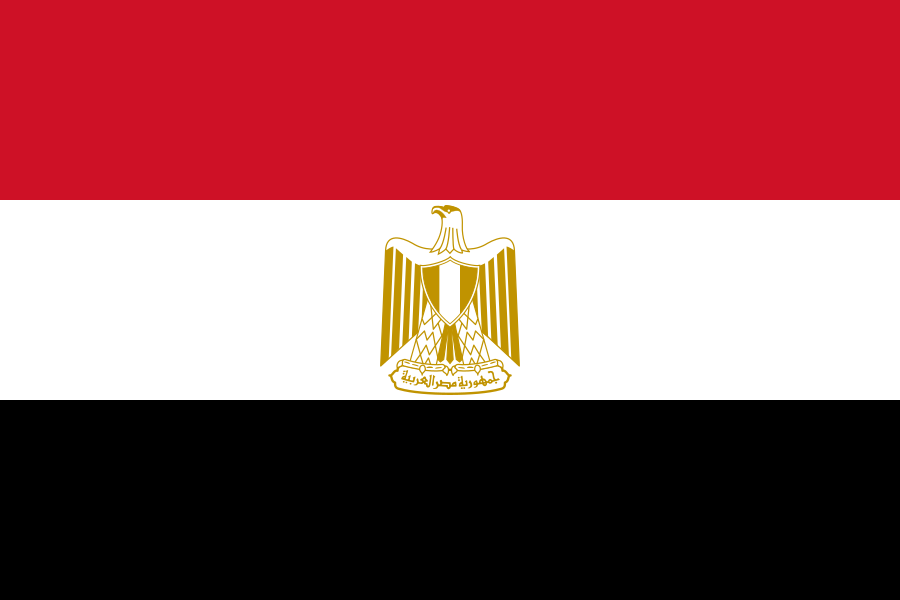
 African programme
Data current as of July 2026
Egypt citizenship
by investment
Launched in 2020 under Law No. 190 of 2019, the programme grants citizenship directly, with no interim residence permit or naturalisation period. An investment from $250,000 qualifies the main applicant, and dual citizenship is permitted without renouncing your current passport. Most of the process is handled remotely, and there is no requirement to live in Egypt before or after you obtain citizenship.
Key advantages of the programme
Benefits of Egypt citizenship
Egyptian citizenship is granted directly, with no interim residence permit and no naturalisation period. Dual citizenship is permitted and there is no language test. The passport gives access to the US E-2 investor visa and to markets across Africa and the Middle East.
How the programme works
Legal basis, authority and application route
What the passport offers
What the investor and their family actually receive
Egypt citizenship cost and investment options
The programme offers four investment options. Below we break down each one, list the government fees and give a full cost estimate for a family of four.
Investment options
The routes approved under the programme
Associated fees
Payable separately from the investment, whichever option you choose
Total cost for a family of four
Based on a couple and two children under 16. At the outset the family receives three passports, with the spouse following after 2 years. Children under 16 are not screened.
Eligibility criteria for Egypt citizenship
The programme sets requirements on age, reputation and source of funds. There are almost no nationality restrictions, which is one of Egypt's advantages over the Caribbean programmes.
Who cannot apply
The list of exclusions is short: the programme is open to almost all nationalities
Requirements for the main applicant
Assessed for every person on the application
Do you need to visit the country
One visit is required while the investment is completed
Including family members in your application
A single investment covers the main applicant, spouse and unmarried children under 21. Neither the investment amount nor the $10,000 government fee increases with family size. Parents, adult children and other relatives cannot be included.
Documents required for Egypt citizenship
A file is prepared for the main applicant and each family member. Below are the main document groups and the formatting requirements.
Application process and timeline
Seven stages from consultation to passport. The process runs in two phases: approval first, then the investment.
Let us calculate the cost for your family
The final amount depends on your family composition, the ages of your children and the investment option you choose. We will prepare a full estimate covering every fee and check whether the programme suits your situation.
Taxes, residency and obligations
Egyptian citizenship alone does not change your tax residency. Residency depends on days spent in the country, not on the passport. Here is what matters on tax.
When tax residency arises
Tax for non-residents
Residency requirements
Passport renewal
Risks, limitations and what the passport does not give
The programme is not for everyone, and a refusal costs more than the fees spent. Below are the causes of refusal and what the passport does not provide.
Grounds for refusal
What most often leads to a negative decision
of funds
background
contradictory file
nationality
health
What the passport does not give
Expectations that the programme does not fulfill
Who the programme is not for
Situations where other options might be more appropriate
What may change
Programme terms are reviewed regularly, plan with margins
How Finextwin supports your application
We lead the process from initial assessment through to the passport and beyond, handling corporate and banking matters as they arise.
What we do that specialist providers do not
A passport is rarely an end in itself. Behind it sit business questions: where to hold the company, where to open an account, how to structure it. We handle these with the same team that ran your application.
Alternative citizenship programmes
Egypt is not the only option, and not always the best one. Below is a comparison with four comparable programmes, including the areas where Egypt falls short.
visa
processing
threshold
inclusion
age limit
Other citizenship programmes
We'll help you choose a programme based on your situation, family composition, and budget

Cases from our practice
Three situations with different budgets, family structures and objectives. We show not just the outcome but what was discussed at the outset.
Real cases from our practice. Client names and outcomes are published with their consent.
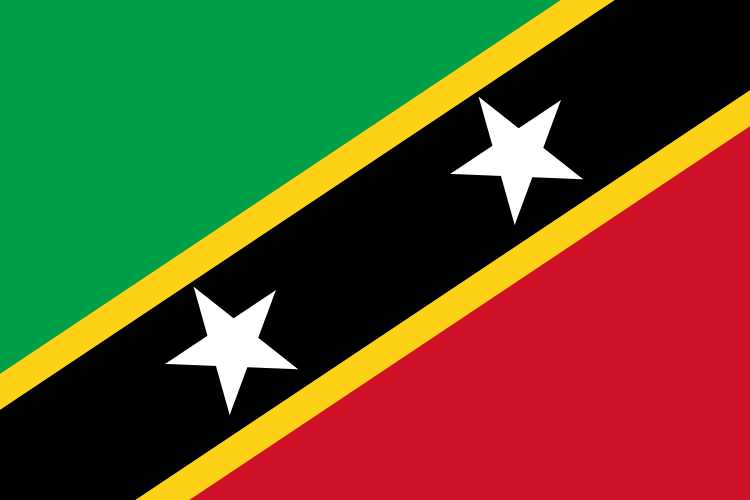 St Kitts and Nevis
 A family of four, a plan B without relocating
The owner of a logistics company in Turkey, an Iranian national. Two children, aged 16 and 11. Relocation was never the point: the business stays where it is, and he wanted a second passport so as not to depend on a single visa basket and to travel freely to Europe and Asia. He was weighing St Kitts against Grenada and leaning towards Grenada on price.
Solution: We costed the full budget for four under both programmes. The gap was narrower than expected, while St Kitts won on passport strength and on how quickly banks recognise it. We went with the fund contribution. Two points were flagged separately: police clearance certificates from Iran and Turkey had to be started first, and the elder son would age out within eighteen months, so there was no room to delay. Biometrics were combined with a business trip to Dubai.
I was convinced Grenada would come out noticeably cheaper and had almost decided. Once both estimates were laid out with every fee, the difference was not enough to justify losing passport quality. My son turning sixteen had not crossed my mind at all, so thank you for saying it straight away rather than once we had already gathered half the paperwork.
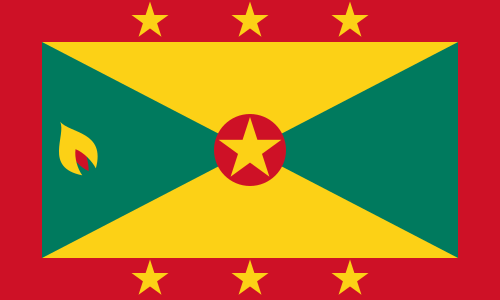
Grenada A single applicant, the goal was business in the US
A developer from Serbia with his own fintech product, his main market being the US. He wanted to set up a company there and run it in person, but no work visa fitted his case on a Serbian passport. He came asking about St Kitts, simply because he had heard of it most.
Solution: St Kitts did not solve his problem. Grenada holds a treaty of commerce and navigation with the US, and that is what opens the door to an E-2 investor visa. We rebuilt the plan: Grenadian citizenship first, then a US company and the visa application. We were upfront that the passport does not grant the visa, that the consulate decides, and that the process would take several more months after citizenship. That was exactly what he had expected.
I came for one thing and left with another, and it turned out to be right. They could have simply sold me what I asked for and I would never have realised I had bought the wrong thing. What I particularly valued was being told straight about the visa: no guarantees, the consulate decides. After two consultations elsewhere where I was promised practically everything at once, that came as a surprise.
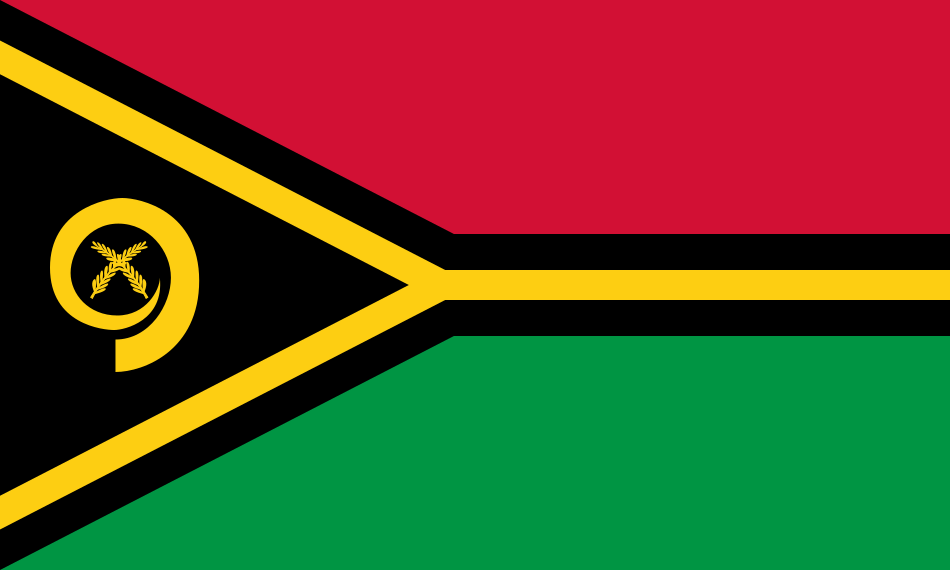
Vanuatu A married couple, budget and timing decided everything
A couple from Kazakhstan, both self-employed: he consults on industrial automation, she runs a small agency. They needed a second document for travel and for opening accounts, with no tie to any particular country. Caribbean programmes were outside their budget, and they did not want to wait six months: a trip was already booked for the autumn, and that was the whole reason behind it.
Solution: On those terms Vanuatu suited them better than anything else: markedly cheaper, with processing measured in weeks rather than months. We set out the limitations at once so there would be no disappointment: the passport is weaker than the Caribbean ones on visa-free access and will not get you into the Schengen area. For their purposes that was acceptable, but the decision was made with eyes open. Documents were gathered in three weeks and both passports arrived together.
We understood that for this money we would not get a passport on the level of St Kitts, and we did not need one. What mattered more was that nobody tried to sell us something pricier and we were told honestly where Vanuatu falls short. The Schengen point was explained upfront, before we had paid anything. My wife was anxious about the timing, but it came in even faster than promised.
Frequently asked questions
Cannot find your answer? Leave a request and we will review your case in person.
Get consultationNo, and no reputable provider offers such a guarantee. The final decision rests with the Egyptian authority, and citizenship is granted by prime ministerial decree. Any provider promising a guaranteed outcome should be treated with caution. What genuinely reduces the risk is an honest assessment of your case before submission and full disclosure of anything the screening would uncover anyway. A helpful feature of the programme is that the investment is made only after approval.
Egypt's list of exclusions is short: nationals of Israel and Iran, and stateless persons, cannot apply. The programme is open to nationals of Russia, Belarus and most other countries, which is one of Egypt's key advantages over the Caribbean programmes. All other nationalities undergo individual security screening. One point to note: an individual on sanctions lists will be refused regardless of nationality.
No. Egypt permits dual citizenship, so there is no need to renounce your current passport. The programme sets no language, history or culture test. Check separately whether your own country allows dual citizenship: some states require notification of a second passport or restrict it.
The programme requires no permanent residence, either before or after you obtain the passport. But at least one visit is needed while the investment is completed: after approval in principle, a six-month temporary residence permit is issued for entry and to finalise the formalities. Most of the process is otherwise handled remotely.
On the most affordable non-refundable contribution option the total is around $266,000. Of this, $250,000 is the contribution itself, $10,000 the government fee for the whole application, around $3,500 due diligence and around $1,500 passport fees. The figures are for a couple and two children under 16. The government fee does not rise with family size. Document legalisation is not included.
The main applicant and everyone aged 16 and over. Indicative fees: around $2,000 for the main applicant, $1,500 for the spouse and $1,000 for children aged 16 to 21. Children under 16 are neither screened nor charged. Due diligence is carried out by the Egyptian security services and takes up most of the timeline, from 3 to 6 months. The fee is non-refundable if the application is declined.
An adult Egyptian passport is valid for 7 years, and a child's for less. Citizenship itself is granted for life and is inheritable; only the document is renewed. There is no in-country requirement to renew: the passport is renewed whether or not you live in Egypt.
A child born after the investor is granted citizenship acquires Egyptian citizenship automatically by right of descent. No separate investment or screening is required, which makes family planning simpler than under the Caribbean programmes, where there is only a narrow window to add a child.
An Egyptian passport gives visa-free or visa-on-arrival access to around 50 destinations, including Hong Kong, Malaysia, Jordan, Seychelles and Mauritius. To be clear: the Schengen Area, the US and the UK all require a visa for Egyptian nationals. Mobility is not this programme's strength. Its value lies elsewhere: direct citizenship, access to the US E-2 investor visa and business entry into the markets of Africa and the Middle East.
A non-refundable treasury contribution from $250,000 is the simplest option. Real estate from $300,000 held for at least 5 years, where you keep the asset. Business from $350,000 plus a non-refundable $100,000 contribution. A $500,000 bank deposit is the only refundable option: the money is returned after 3 years, but in Egyptian pounds at the exchange rate on the withdrawal date, so there is a currency risk. The choice depends on whether the minimum amount or preserving your capital matters more.
the budget and assess
your eligibility
We will tell you straight if the programme is not right for you.
Get an estimate
We will reply within one working day and prepare an estimate for your family
By clicking "Send request", you agree to the processing of your personal data in accordance with the Privacy Policy.