Vanuatu citizenship in 2026: what the passport gives you and what it no longer does
Contribution from 130,000 dollars, six weeks to three months, the full budget with every fee and an honest picture of where you can travel

The short version: what a Vanuatu passport gives you in 2026
Vanuatu remains the fastest citizenship by investment programme in the world. Anywhere from six weeks to three months from application to passport. No Caribbean programme works at that speed.
The contribution starts at $130,000 under the development support route. There is a second route with a partly redeemable component, covered in section four. The full budget including every fee is higher than the headline figure, and that gap gets its own section.
Vanuatu levies no income tax, no capital gains tax, no inheritance tax and no wealth tax. A real advantage for anyone planning to change tax residence, and of no use whatsoever to anyone who is not.
And the point that makes the rest of this worth reading. The Vanuatu passport no longer carries visa-free access to the Schengen area or the United Kingdom. The EU suspended the visa waiver in March 2022, and on 12 December 2024 the Council of the EU permanently removed Vanuatu from the visa-exempt list. The United Kingdom imposed visa requirements in July 2023. Any material promising you Schengen access on a Vanuatu passport in 2026 either has not been updated or is misleading you.
That does not mean the programme has lost its purpose. It means the purpose is now a different one, and a $130,000 decision is worth taking with a clear view of which.
What changed: how Vanuatu lost Schengen and the UK
2016 to 2017. Vanuatu launches its citizenship by investment programmes. The headline argument is visa-free access to the Schengen area at half the Caribbean price and in a matter of weeks.
2019 to 2021. The European Commission conducts a review and concludes that applicant vetting in Vanuatu is inadequate. The authorities are asked to strengthen it.
March 2022. The Council of the EU suspends the visa waiver agreement. The suspension is presented as temporary, with the possibility of restoration once reforms are made.
July 2023. The United Kingdom removes Vanuatu from its list of visa-exempt countries by separate decision.
12 December 2024. The Council of the EU terminates the visa exemption permanently and removes Vanuatu from the relevant list. What was temporary became settled. The stated reason is risk associated with citizenship by investment programmes.
What this means in practice. A Vanuatu national today applies for a Schengen visa on ordinary terms, exactly as a national of a country with no agreement would. Entering the United Kingdom requires a visa. The passport people bought for European mobility no longer performs that function.
Will access be restored? Some industry material promises a return of the visa waiver and names dates. Treat those forecasts with caution: the December 2024 decision was taken precisely because the temporary suspension had not produced the changes required. Restoration would need a fresh Commission assessment and a Council decision, and no public commitment on timing exists. Buying a passport on the expectation of future restoration is a bet, not a strategy.
Separately on the United States. Long-term multiple-entry visas are not issued to Vanuatu passport holders. A single-entry B1/B2 visitor visa valid for up to three months is available. Worth factoring in if the US features in your plans.
Where you can actually travel
A realistic figure for 2026 is 90 to 96 destinations including visa on arrival and electronic authorisations. Counting only entry with no formality at the border, the number is noticeably lower.
What is genuinely available and genuinely useful. Singapore and Hong Kong, which for anyone doing business are the most valuable entries on the list. Malaysia, Indonesia, Israel. Most of the Pacific: Fiji, Samoa, the Solomon Islands, the Marshall Islands. A substantial part of the Caribbean: the Bahamas, Barbados, the British Virgin Islands, the Cayman Islands. A number of destinations in Africa and South America, mostly on visa on arrival.
What is not there. The Schengen area. The United Kingdom. Ireland. Long-term US visas. Canada, Australia and New Zealand all require visas, though Vanuatu’s Commonwealth membership carries some procedural advantages when applying for long-stay visitor visas.
How to read this geography. The Vanuatu passport today is a mobility instrument for the Asia-Pacific region and a backup travel document, not a key to Europe. For someone whose primary passport already provides European access, losing Schengen may be immaterial. For someone who would be buying the passport specifically for Europe, the programme does not fit, and it is better to know that now.
Two routes: the contribution and the fund with a redeemable component
The development support programme. The classic option: a non-refundable donation to the national fund. The contribution starts at $130,000 for a single applicant and rises for a family depending on composition. The money is not returned under any circumstances. This route carries the shortest processing time available anywhere on the market.
The route with a redeemable component. A newer construction: a contribution of around $115,000 plus an investment of about $50,000 which is redeemable after four years subject to conditions. The total outlay at entry is higher, but part of the capital comes back. Processing is usually longer, roughly two to three months against six weeks to two.
How to choose between them. If the priority is the lowest total outlay and maximum speed, the first works. If the priority is retaining part of the capital and you are willing to lock funds for four years and wait longer, the second is more sensible. Redeemability here is conditional: it depends on meeting the terms and on the programme continuing in its present form for the full period. Nobody can guarantee the return, and that belongs in your calculation.
One thing to understand about both. Vanuatu’s programme terms have changed more than once in recent years. The amounts, timelines and requirements in force on the date of your application need confirming separately, not taken from an article, however recent.
The full budget: why $130,000 is not the final figure
Applicant vetting. The due diligence fee runs to somewhere between $5,000 and $7,500 depending on route and year. The critical detail: this fee is not refunded on refusal. Vetting is carried out by Vanuatu’s Financial Intelligence Unit, and its decision is not subject to appeal.
Biometrics. Biometric data collection has recently become mandatory for every applicant regardless of age. The fee is around $500 if given in Vanuatu and roughly $1,500 at the programme’s overseas offices. On top of the fee sit flights and accommodation if the trip has to be made specially.
National identity card. A separate fee of around $2,500.
Authorised agent fees. Direct applications are not accepted in Vanuatu: the file is submitted by a government-authorised agent. Their fee is payable separately from the state charges.
Ancillary costs. Legalisation and translation of documents, notarial fees, courier delivery, bank charges on international transfers.
A realistic marker. For a single applicant the total budget usually lands 15 to 25% above the headline contribution. For a family the gap is wider, because several of the fees are charged per participant.
What to clarify before applying. A full schedule of payments broken down by recipient and the order in which they fall due. If a service provider quotes one figure and will not break it down, that is a reason to ask more questions rather than fewer.
Requirements and who does not get through
What is not required. Residence in the country before or after obtaining citizenship. Language ability. A degree. Evidence of business experience. Renouncing your current citizenship: Vanuatu permits multiple citizenship, though you also need to check your own country’s law, since some states do not allow it.
What is required. Age 18 or over. No criminal record, evidenced by police certificates from countries of residence. Evidence of the lawful origin of funds. No refusals under other citizenship by investment programmes: this question is asked, and non-disclosure comes out.
Family composition. A spouse, children and dependent parents can be included. Conditions around children’s and parents’ age and dependency change, so confirm them at the point of application.
Nationality restrictions. Applicants from a number of countries, including Iran, Iraq, North Korea, Yemen and Venezuela, are generally not accepted. Exceptions are possible where there has been a long separation from the country, typically ten years or more without residence, significant assets or business operations there, but these are considered individually and with no predictable outcome.
Why applications are refused. Inconsistencies in source of funds documentation. Unresolved questions in a biography. A refusal under another programme that was not disclosed. Presence on sanctions or adverse media databases. Vetting has tightened in recent years under external pressure, and that direction continues.
An important point about money. The vetting fee is paid before the vetting happens and is not returned on refusal. So a preliminary assessment of whether an application will get through, done before documents are filed, has direct monetary value.
The process step by step
Step 2. Document collection, one to three weeks. Passports, birth and marriage certificates, police certificates, source of funds documentation, bank confirmations. Most of the time goes on certificates and legalisation rather than on filling in forms.
Step 3. Submission through an authorised agent and payment of the vetting fee. Direct submission is not possible.
Step 4. Due diligence, two to four weeks. Carried out by Vanuatu’s Financial Intelligence Unit. Follow-up questions are possible, and how quickly you answer them affects the overall timeline.
Step 5. Approval in principle. The contribution to the fund is paid after this.
Step 6. Biometrics. Given by every applicant, in Vanuatu or at an overseas office of the programme. Plan this step early: it requires travel and a booked appointment.
Step 7. Certificate of citizenship and oath of allegiance.
Step 8. Passport issue. Since late 2025 Vanuatu has issued biometric passports to international standards, which has improved the technical quality of the document.
A realistic total is six weeks to three months on the contribution route and two to three and a half months on the route with a redeemable component. Promises of “two months, turnkey” without qualification are best treated as an indication rather than a commitment: the timeline depends on vetting, and vetting is carried out by a government body.
Tax, confidentiality and what the passport does not solve
What is true. Vanuatu has no income tax, no capital gains tax, no inheritance tax and no wealth tax. The country does not participate in some information exchange mechanisms to the extent developed jurisdictions do.
What is not true. A Vanuatu passport does not by itself change your tax residence. Tax residence is determined by where you are physically present and where your centre of vital interests sits, not by which document is in your pocket. Someone who buys a passport and carries on living in their previous country remains a tax resident of that country with all the obligations that entails.
What is needed for the tax benefit to be real. An actual change of country of residence, exit from the previous tax residence under that country’s rules, and confirmation of the new status. That is a separate project, in which the passport is one instrument rather than the solution.
One obligation that applies almost everywhere. Many countries require their tax residents to notify the authorities of acquiring a second citizenship, within a set period and with penalties for missing it. Obligations relating to controlled foreign companies and foreign accounts continue for as long as the previous tax residence does. A second passport does not remove them. Check your own country’s rules before applying, not after.
Confidentiality: what is actually so. Vanuatu does not maintain a publicly searchable register in which a new citizen can be found by name. The programme does not require you to disclose participation to an employer or business partners.
What is not so. Complete confidentiality does not exist under any programme. A bank opening an account asks about every citizenship and every tax residence, and completing that form with an omission is not privacy but a false declaration with consequences. International exchange of financial information is built on self-declared tax residence rather than on citizenship, so a second passport offers no shelter from it. Immigration authorities see the circumstances of a citizenship grant when reviewing visa applications, and the origin of a passport matters.
A separate reputational point. Since the EU and UK decisions, the origin of a Vanuatu passport prompts additional questions from some banks and visa authorities. Not a prohibition, but a factor to build into the plan: a document bought to simplify things can in certain situations complicate them.
What the passport actually solves. Entry and stay in the countries it covers without a visa. A backup travel document if there are problems with the primary one. The ability to travel where restrictions apply. Grounds for opening certain accounts and structures. That is not nothing, but it is a different list from tax optimisation.
Comparison with the Caribbean programmes and Nauru
The Caribbean programmes: St Kitts and Nevis, Grenada, Dominica, Antigua and Barbuda, Saint Lucia. Contributions from $200,000 to $250,000 depending on programme and family composition. Timelines of four to six months and beyond. The key difference: visa-free access to the Schengen area and the United Kingdom
is intact. That is what the price difference buys.
An honest caveat is due: the Caribbean programmes sit under the same European scrutiny Vanuatu once did. Requirements are tightening, and nobody guarantees continued access over a long horizon.
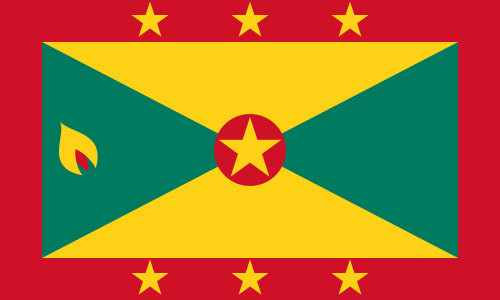
Grenada separately. The only Caribbean programme with a live treaty of friendship, commerce and navigation with the United States, giving access to the E-2 visa category. For anyone who needs a route into the US, that is an argument neither Vanuatu nor the others can offer. More on Grenada citizenship.
St Kitts and Nevis. The oldest programme, running since 1984, with the widest visa access among the Caribbean options. Chosen where the document’s standing matters. More on St Kitts and Nevis citizenship.
Nauru. A Pacific programme with a lower entry threshold. Its access geography sits closer to Vanuatu’s than to the Caribbean. Considered where the budget is constrained and Europe is not the objective. More on Nauru citizenship.
How to choose. If you need European access, the Caribbean programmes justify their price. If European access is already covered by your primary passport or is not needed, Vanuatu delivers substantially the same for half the money and three to four times faster. If you need a route into the US, Grenada. All active programmes are set out in the immigration section.
Who it suits and who it does not
It does not suit. Anyone whose main objective is visa-free Europe or the United Kingdom: the passport does not provide it and may not provide it for the foreseeable future. Anyone who needs long-term US visas. Anyone expecting to solve a tax question without relocating. Anyone looking for opacity.
A separate category. Anyone who cannot accept losing the vetting fee on refusal. It is not returned, and the outcome of vetting cannot be predicted. If that risk is unacceptable to you, start with a preliminary assessment of the application and decide on submission afterwards.
Frequently asked questions
If your question is not answered here, get in touch and we will go through your situation with you.
Book a consultationNo. The EU suspended the visa waiver in March 2022, and on 12 December 2024 the Council of the EU permanently removed Vanuatu from the visa-exempt list. The United Kingdom imposed visa requirements in July 2023. Material claiming otherwise has not been updated.
The contribution starts at 130,000 dollars for a single applicant under the development support programme. Added to it are a due diligence fee of 5,000 to 7,500 dollars, an identity card fee of around 2,500 dollars, biometrics from 500 dollars, authorised agent fees and document costs. A realistic budget usually runs 15 to 25 per cent above the headline contribution.
Yes, if you give biometrics there. Biometric data is mandatory for every applicant regardless of age, and it can be given either in Vanuatu or at an overseas office of the programme. The process is no longer entirely remote.
Six weeks to three months on the contribution route, two to three and a half months on the route with a redeemable component. That remains the shortest timeline of any active citizenship by investment programme.
Vanuatu permits multiple citizenship. You need to check your own country law: some states do not recognise a second citizenship or require notification of it, often within a set period and with penalties for missing it.
No. A passport does not change tax residence, which is determined by where you actually live and where your centre of vital interests sits. The tax benefit only materialises on an actual move and exit from the previous residence under that country rules.
The contribution to the fund is paid after approval in principle, so it is not paid at all if the application is refused at vetting stage. The due diligence fee, however, is paid before vetting and is not refunded.
There is no public commitment on timing. The December 2024 decision followed the failure of the 2022 temporary suspension to produce the changes required. Restoration would need a fresh Commission assessment and a Council decision. Building a plan on that expectation is not advisable.
What to do next
The right order for making the decision is straightforward. First define the task: what exactly you want a second passport to do and in which countries it needs to work. Then check whether Vanuatu answers that task or whether it calls for a Caribbean programme on a different budget. Only then work through the money and the timelines.
Finextwin is an international corporate services firm with offices in Hong Kong and Tbilisi. Over 6+ years we have worked across 30+ jurisdictions with more than 1,250 clients. We carry out a preliminary assessment before any payments are made, prepare the document pack and support submission through the programme’s authorised agents. The decision belongs to the Vanuatu government and nobody can guarantee it: our job is to remove the reasons for refusal in advance and to keep you from losing a non-refundable vetting fee. A manager responds within 30 minutes.
Popular programmes
 Africa
 Sao Tome and Principe
The most affordable citizenship by investment programme
 Oceania
 Nauru
A Pacific programme with a moderate entry threshold
 Caribbean
 Grenada
Caribbean citizenship with access to the US E-2 visa
and suggest a solution
The consultation is free
Get a consultation
Send a request. We'll get back to you within 30 minutes and find a solution for your task
By clicking "Send request", you agree to the processing of your personal data in accordance with the Privacy Policy.
Related articles
Analysis, practical guidance and news on corporate structures, payments and immigration.
Where to register a company as a non-resident in 2026
A practical review of jurisdictions for international business
Payment solutions
Where to open an account for a foreign company
How to pass compliance checks and improve your chances of approval
Company registration
Where to set up a company for an AI project in 2026
The strongest jurisdictions for an artificial intelligence business