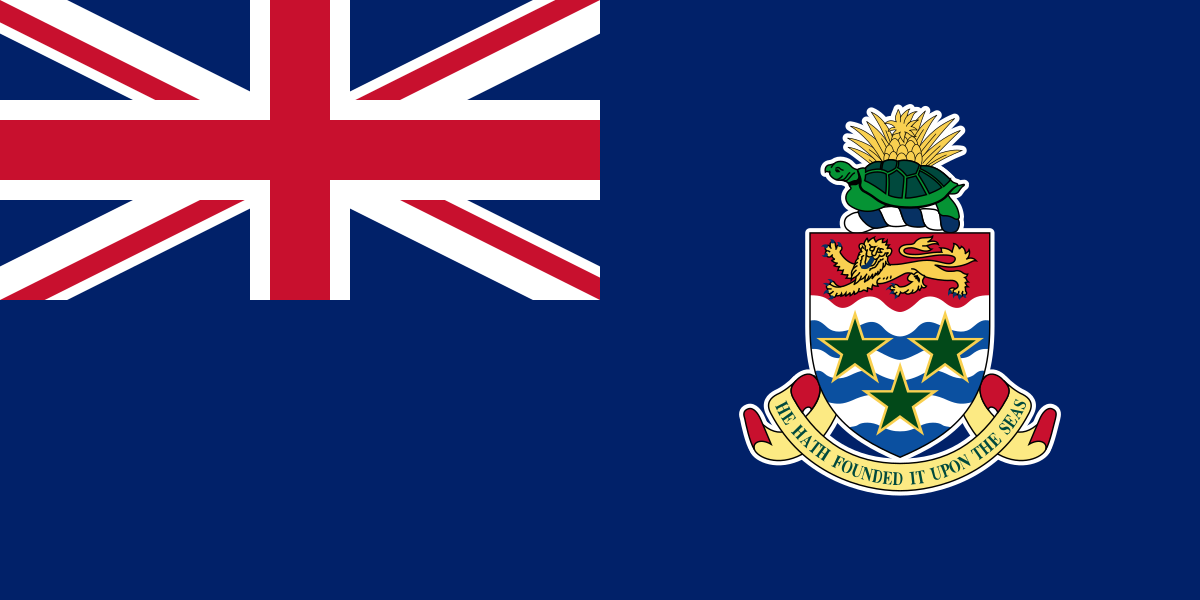
Flag of the Cayman Islands Company formation for non-residents

Company registration in the Cayman Islands

We form exempted companies and Cayman LLCs - the two structures that carry most international business here. A British Overseas Territory built on English common law, with no corporate tax. The beneficial ownership register is not public: access requires a proven legitimate interest. We draft the memorandum and articles, file through a licensed provider, and keep the company in good standing afterwards. Everything is handled remotely.

6+ years
in corporate services
30+
jurisdictions
1,250+
clients worldwide
Cost
from $3,800
Timeline
from 7 days
Format
fully remote
Key facts

Key facts on company registration in the Cayman Islands

Corporate, tax and annual filing requirements for non-resident owners in 2026.

Company type

Exempted company and LLC

The exempted company is formed under the Companies Act: shares, directors, memorandum and articles. The Cayman LLC, introduced in 2016, follows the Delaware model - members hold interests rather than shares, and an LLC agreement replaces the articles. Both trade outside the islands. Fund structures typically use an exempted limited partnership instead.

Foreign ownership

100%

Neither directors nor shareholders need to be resident. One of each is enough, and the same person may hold both roles. Corporate directors are permitted and there are no nationality restrictions. The register of directors is filed with the Registrar of Companies but is not open to public inspection.

Registered office

Mandatory

Every company must maintain a registered office in the Cayman Islands with a provider licensed under the Companies Management Act. Filings reach the Registrar through that provider, never directly. The same provider maintains the beneficial ownership register and reports to the centralised platform.

Corporate tax

0%

The Cayman Islands levy no corporate tax, no capital gains tax, no withholding tax on dividends or interest, and no inheritance tax. A company may also obtain a Tax Exemption Certificate, a government undertaking that no such taxes will apply to it for 20 years. Tax still arises where the beneficial owner is resident.

Economic substance

Depends on activity

Every company files an economic substance notification each year without exception - the annual return will not be accepted without it. The full substance test applies only to the nine relevant activities. A pure equity holding company falls under the reduced test and usually satisfies it through its registered office provider.

Annual obligations

Fee and filings

The annual government fee is around $1,128 for an exempted company with authorised share capital up to $50,000, and around $1,341 for an LLC. Add the annual return, the substance notification and renewal of the registered office. No financial statements are filed with the Registrar - the company keeps its own books.

The final cost depends on the package you choose, your authorised share capital, the provider's fees and any additional work on the project.

Information current as of July 2026.

Packages

Cost of company registration in the Cayman Islands

From a basic exempted company incorporation to a full package with annual maintenance and banking support.

Start

Basic exempted company incorporation

US$ 3 800
Exempted company incorporation
Name check and reservation with the Registrar of Companies
Drafting the memorandum and articles of association
Payment of the government incorporation fee
Filing with the Registrar and issue of the certificate of incorporation
Appointment of a licensed provider as registered office
Request a quote

Full service

Director, shareholder and documents

US$ 5 900

For launching an exempted company with director and shareholder services, a full set of corporate documents and support in choosing a banking solution.

Everything in Corporate, plus:
Director and shareholder services for one year
Document pack: power of attorney, declaration of trust, apostille
Advice on payment solutions and choosing a bank
Request a quote

Important: we advise on choosing a bank or payment provider and help you prepare the application, but we cannot guarantee that an account will be opened. The final decision always rests with the bank or EMI after it has reviewed the company and its beneficial owners.

Use cases

Typical use cases for a Cayman Islands company

A British Overseas Territory built on English common law, with no direct taxation. Most of the world's offshore hedge funds are domiciled here, which is why investors, banks and exchanges already know how to read the structure.

Where the jurisdiction fits

Funds and investment structures

This is what the islands were built for. An exempted limited partnership for venture and private equity funds, an exempted company for the manager or the SPV. LPs in the US and Europe recognise the structure on sight, so nothing needs explaining when the round closes.

Holding and asset ownership

Holding shares in operating companies, portfolio investments and intellectual property rights. A pure equity holding company falls under the reduced economic substance test and needs no local office or staff on the ground.

Crypto and token projects

A large share of token issuers and DAO structures sit here. The common pairing is a foundation company as the issuer and an exempted company for operations. Virtual asset services are licensed by CIMA - you cannot operate without one.

Redomiciliation from another jurisdiction

The Companies Act allows a foreign company to continue into the Cayman Islands, keeping its incorporation date, its history and its contracts. The government fee matches a standard incorporation. A common route for structures leaving the BVI or Singapore at an investor's request.

Why clients choose the Cayman Islands

No direct taxation

No corporate tax, no capital gains tax, no withholding tax on dividends or interest, no inheritance tax. A company may also secure a Tax Exemption Certificate, locking in that position for 20 years.

Beneficial ownership register is not public

Beneficial ownership data sits on a centralised platform and is not open to public search. Access runs through an application and a proven legitimate interest - journalists, researchers and counterparties - and only where the purpose relates to preventing money laundering.

English common law and standing

A British Overseas Territory with final appeal to the Privy Council in London. Prospectuses, term sheets and corporate documents drafted for a Cayman entity land on the desks of US and European counsel without redrafting.

Off the EU and FATF lists

The FATF removed the Cayman Islands from its grey list on 27 October 2023, and the EU delisted the jurisdiction as a high-risk third country on 7 February 2024. EU financial institutions no longer apply enhanced due diligence on the basis of Cayman domicile alone.

Requirements

Requirements for registering a company in the Cayman Islands

To incorporate an exempted company you will need documents for the shareholders and the director, plus a decision on the authorised share capital. Every step runs remotely through a licensed provider.

What you will need to provide

  • Passport of each shareholder, director and beneficial owner
  • Proof of residential address, dated within the last three months
  • Bank or professional reference for each beneficial owner
  • Description of the business and the source of funds
  • Where your counterparties are based and your expected turnover
  • Three proposed company names

The exact list depends on the ownership structure, where the beneficial owners are resident, and the standards of the provider involved. Fund structures require more.

01

Directors

One director is enough - an individual or a body corporate, of any nationality. No Cayman residency is required, and there is no obligation to hold an annual general meeting. The register of directors is not open to public inspection.

02

Shareholders and beneficial owners

One shareholder is enough, individual or corporate, and the same person may also serve as director. The register of members is kept by the company and is not open to public inspection. Beneficial ownership data goes to the centralised platform through your provider, and access to it is restricted.

03

Registered office

Required by law. The registered office is provided by a firm licensed under the Companies Management Act, and filings reach the Registrar of Companies through it rather than directly. A company secretary, by contrast, is not required at all.

04

Company name

Latin script. Unlike most jurisdictions, an exempted company does not have to carry Limited or Ltd in its name. Only a Cayman LLC may use the LLC abbreviation. Words such as bank, trust, insurance and royal need the Registrar's consent, or are barred outright.

05

Authorised share capital

There is no minimum, and a single issued share will do. But government fees are calculated on the authorised capital, not the paid-up amount. The market standard is $50,000 divided into 50,000 shares of $1 - the ceiling for the lowest fee band. Set it higher and you pay more every year, whether or not the company trades.

Tax and reporting

Cayman Islands corporate tax and annual reporting

There is no direct taxation of any kind - no corporate tax, no capital gains tax, no withholding tax. What the jurisdiction asks for instead is annual filings: the annual return, the economic substance notification and current beneficial ownership data.

Corporate tax

0%

no direct taxation exists in the Cayman Islands in any form

Withholding tax

0%

dividends, interest and royalties leave the jurisdiction untaxed

Economic substance

notification required

every company files a notification; the full test applies to nine activities

Financial statements

not filed

no audit required; the company keeps its own books

How taxation works here

No direct taxation

The Cayman Islands levy no corporate tax, no income tax, no capital gains tax, and no gift, inheritance or wealth tax. This is not a relief or a special regime - those taxes simply do not exist here. Stamp duty may apply to certain documents and is generally nominal.

What the company pays the government

An annual fee, calculated on the authorised share capital: around $1,128 for an exempted company with capital up to $50,000, and around $1,341 for an LLC. Turnover and profit make no difference - only the figure stated in the memorandum does.

Tax Exemption Certificate

A company may obtain a written undertaking from the government: should direct taxes ever be introduced in the Cayman Islands, they will not reach it for 20 years. The period can be extended. For funds and long-horizon structures this is routine.

Annual obligations

File the annual return with the Registrar of Companies and pay the annual fee - due by 31 December for the year ahead

File the economic substance notification in January - the annual return will not be accepted without it

File an economic substance return if the company carries on one of the nine relevant activities

Keep beneficial ownership data current with your provider whenever anything changes

Keep proper books of account: income, expenditure, assets and liabilities. They are not filed with the Registrar, but must be produced if the authorities ask

The Cayman Islands take part in automatic exchange of information under CRS and FATCA and belong to the OECD Inclusive Framework on BEPS. A zero rate here does not relieve the beneficial owner of tax where they are resident - check the CFC rules in your own country before you incorporate.

Information current as of July 2026.

Banking solutions

Opening a bank account for a Cayman Islands company

The islands do have banks, but they are geared towards funds and large structures. For a company without real turnover, the working route is payment providers and banks in third countries. To be blunt: banking here costs more and takes longer than the incorporation itself, so start preparing early.

Payment providers (EMI)

The quickest way in for an early-stage project. Live in weeks, multi-currency details, opened remotely with no visit. A Cayman company clears EMI onboarding more easily than a classic offshore entity, though source of funds is still asked for.

  • Multi-currency details
  • International transfers
  • Online banking

Cayman and third-country banks

Butterfield, Cayman National and RBC work with Cayman structures, but the entry bar is high and the review cycle long. Switzerland, Singapore and the UAE take these companies too. Since the EU and FATF delistings, banks no longer apply enhanced due diligence on domicile alone - but they still ask about the substance of the business and the balance you intend to hold.

  • Corporate account in USD
  • International transfers
  • Multi-currency operations
Finextwin support

Compliance preparation

Compliance looks at good standing, source of funds and whether the operations are real. With the Cayman Islands there is one more question: what is the company's economic substance position, and who files the notifications. That answer has to be ready in advance, not assembled on the call.

  • Business description
  • Payment structure
  • Contracts and counterparties

Not sure which banking route fits your project?

We will assess your activity, payment geography and bank requirements before any application goes in.

Discuss your project
Registration process

How company registration in the Cayman Islands works

Filing with the Registrar of Companies takes 3 to 5 working days, with express filing available within 24 hours. Most of the time goes on the provider's compliance checks. Every step runs remotely.

01

Compliance and name reservation

What happens The licensed provider runs checks on the shareholders, the director and the beneficial owners, assesses the nature of the business and clears the name against the register. The name can be reserved for up to four months.
From you Participant documents, a bank or professional reference, evidence of the source of funds, and your proposed names.
Outcome Checks cleared, name approved and reserved.
02

Drafting the constitutional documents

What happens We draft the memorandum and articles of association, fix the authorised share capital and the share structure, and prepare the declaration that the company will trade outside the islands.
From you A decision on the authorised share capital, confirmation of the details and signed forms.
Outcome The pack is ready to file.
03

Filing through the licensed provider

What happens The provider files with the Registrar of Companies and pays the government fee, which is calculated on the authorised share capital. The company is entered on the register within 3 to 5 working days.
From you Nothing further is usually needed unless the Registrar comes back with queries.
Outcome Company incorporated, certificate of incorporation issued.
04

Statutory registers and handover

What happens We set up the registers of members and directors, issue the shares, file the beneficial ownership data to the centralised platform, and walk you through the annual obligations.
From you Confirmation of receipt and a check of the corporate details.
Outcome A company in good standing, with full registers and a complete document pack.

What you receive

Certificate of incorporation

Proof of registration, issued by the Registrar of Companies.

Constitutional documents

The company's memorandum and articles of association.

Registers and shares

Register of members, register of directors, share certificates.

Corporate pack

First resolutions, power of attorney and the forms included in your package.
The register of members is kept by the company; the register of directors is filed with the Registrar but is not open to public inspection. The format of the pack, and whether you need originals, apostilles or translations, depends on what you are doing with the company and which package you choose.
Limitations and alternatives

When the Cayman Islands are not the right fit

The Cayman Islands carry the strongest reputation in the offshore segment - and the highest price tag. Here are the honest drawbacks, and the jurisdictions that solve them.

When another jurisdiction makes more sense

High cost of ownership

The government fee alone runs to about $1,128 a year, before the provider's charges. For a straightforward holding or trading structure, that is several times what you need to pay. The islands earn their keep when there are investors or a fund behind the company.

Annual filings are compulsory

Every company files an economic substance notification, no exceptions. Add the annual return and keeping beneficial ownership data current. Miss a filing and you face penalties and, eventually, strike-off.

The fee scales with your capital

The fee is calculated on the authorised share capital, not the paid-up amount. The standard is $50,000. Set it higher to leave room for growth, and you pay several times more every year - even with no trading at all.

Licensed activities

A company cannot trade within the islands without a licence. Banking, insurance, trust business, fund management and virtual asset services all require authorisation from CIMA.

What to consider instead

Results

Real cases from our clients

Every project is different - we tailor the solution to the specific task, jurisdiction and business model.

Company registration
Flag of the Cayman Islands Cayman Islands

Holding company for a venture round

A product team out of Tbilisi, engineering in Georgia, customers in the US. They raised a pre-seed and moved on to a Series A. The San Francisco fund set the condition straight away: the holding company goes to the Cayman Islands, the operating company stays in Georgia. There was no point arguing - the fund runs the same structure across its entire portfolio.

Solution We set up an exempted company as the top holdco, with the Georgian entity underneath. Authorised capital was set at $50,000, the standard figure that keeps the fee at its lowest band. The fund's counsel sent through their requirements for the articles and we built them in. Done two weeks before the term sheet was signed - the round did not slip.


14 days to a working holding company
Series A round stayed on schedule

I did try to argue. I said, look, we have a Georgian company, everything is clean, why do we need islands. They came back with - without a Cayman holdco the investment committee simply will not take the deal to the table, this is not up for discussion. Arguing with someone else's compliance costs more than just registering the company.

AK
Artem K. Founder, SaaS
Company registration
Flag of the Cayman Islands Cayman Islands

Structure for a token project

An infrastructure protocol with a distributed team, planning a token launch. Their lawyers insisted on separation: the issuer as one entity, the operating company as another. They looked at the BVI, but their US investors asked outright why not the Cayman Islands - three companies from that portfolio were already sitting there.

Solution A foundation company as the issuer, an exempted company for operations. We flagged it early: virtual asset services are licensed by CIMA, and if the project moves towards custody, that licence becomes mandatory. The client factored it in from day one. Accounts opened with an EMI, with a bank application to follow.


2 entities issuer and operations
3 weeks to working payment details

We spent a month choosing between the BVI and Cayman, running the numbers on the difference. Then the investor just said - guys, I do not want to sit there explaining to my committee what the BVI is. And that was that. The licensing point, by the way, we heard from you, not from our own lawyers.

DM
David M. Web3 protocol
Company registration
Flag of the Cayman Islands Cayman Islands

Moving a company from the BVI

A BVI company, five years old, holding stakes in two operating businesses. When a new investor came in, their lawyers dug their heels in: the mandate only allows investment into Cayman structures. Setting up a fresh company and moving the assets across was not an option - the history would be lost, and so would some of the contracts.

Solution We went the redomiciliation route: the company continued into the Cayman Islands, keeping its incorporation date and every live contract. The government fee matched a standard incorporation. Along the way we cleaned up the old registers and refiled the beneficial ownership data. The investor came in six weeks later.


5 years of history company preserved
6 weeks from decision to investor entry

I was certain we would have to wind up the old company and re-sign everything. Three of those contracts run five years out - I would not have survived renegotiating them. When they told me the company simply moves and stays itself, I asked twice. It works.

OB
Oliver B. Investment holding
FAQ

Frequently asked questions

If your question is not covered here, send us a request and we will look at your situation directly.

Book a consultation

Filing with the Registrar of Companies takes 3 to 5 working days, with express filing available within 24 hours. But that is the last step. What really sets the timeline is the licensed provider's compliance work: checks on the beneficial owners, the source of funds and the nature of the business. Allow at least seven days for incorporation, and a separate few weeks for the bank account - these are different stages of the project.

Yes, and it is not a relief - the taxes simply do not exist. There is no corporate tax, no capital gains tax, no withholding tax on dividends or interest, and no inheritance tax. A company can also obtain a Tax Exemption Certificate, a written undertaking from the government not to tax it for 20 years should such taxes ever be introduced. That said, a zero rate here does not remove tax where the beneficial owner is resident - check your own CFC rules before you incorporate.

No. The FATF removed the jurisdiction from its grey list in October 2023, and the EU delisted it as a high-risk third country in February 2024. In practice that means EU banks and financial institutions no longer apply enhanced due diligence on the basis of Cayman domicile alone. It is one of the clearest lines between the Cayman Islands and most offshore jurisdictions.

No. Every stage runs remotely: compliance, signing the documents, filing through the licensed provider. The director and the shareholder can be resident anywhere, and there is no local presence requirement. The company is not even obliged to hold an annual general meeting. Where original documents are needed, we send them by courier.

Beneficial ownership data sits on a centralised platform and is not open to public search. Access runs through an application and a proven legitimate interest - journalists, researchers and counterparties - and only where the purpose relates to preventing money laundering. The register of members is kept by the company; the register of directors is filed with the Registrar but is not publicly disclosed. The government has confirmed it does not intend to introduce an openly public register.

It depends on the activity, but every company files a notification without exception. The full substance test applies only to the nine relevant activities: banking, insurance, fund management, financing and leasing, headquarters business, shipping, distribution and service centre business, intellectual property and holding company business. A pure equity holding company falls under the reduced test and usually satisfies it through its registered office provider. Penalties for breaching the regime run to CI$100,000.

No financial statements go to the Registrar and no audit is required. But the annual filings are compulsory: the annual return with the Registrar of Companies, and the economic substance notification in January - without it, the annual return will not be accepted. The government fee is due by 31 December for the year ahead: around $1,128 for an exempted company and around $1,341 for an LLC. The company keeps its own books of account and produces them if the authorities ask.

No, and nobody can. We advise on choosing a bank or payment provider, prepare the file and help you through compliance, but the final decision always rests with the bank or EMI once it has reviewed the company and its beneficial owners. With the Cayman Islands there is one more question in the mix: what is the company's economic substance position, and who files the notifications. That answer needs to be ready in advance.

The exempted company is the classic structure: shares, shareholders, directors, a memorandum and articles of association. The Cayman LLC, available since 2016, follows the Delaware model - members hold interests rather than shares, an LLC agreement replaces the articles, and governance is more flexible. US clients often prefer the LLC because the form is familiar to them, and it is frequently used as the general partner in fund structures. For a holding company backing a venture round, the market standard is the exempted company.

We'll assess your task and suggest a solution
We work with clients from any country
The consultation is free

Get a consultation

Send a request. We'll get back to you within 30 minutes and find a solution for your task

By clicking "Send request", you agree to the processing of your personal data in accordance with the Privacy Policy.